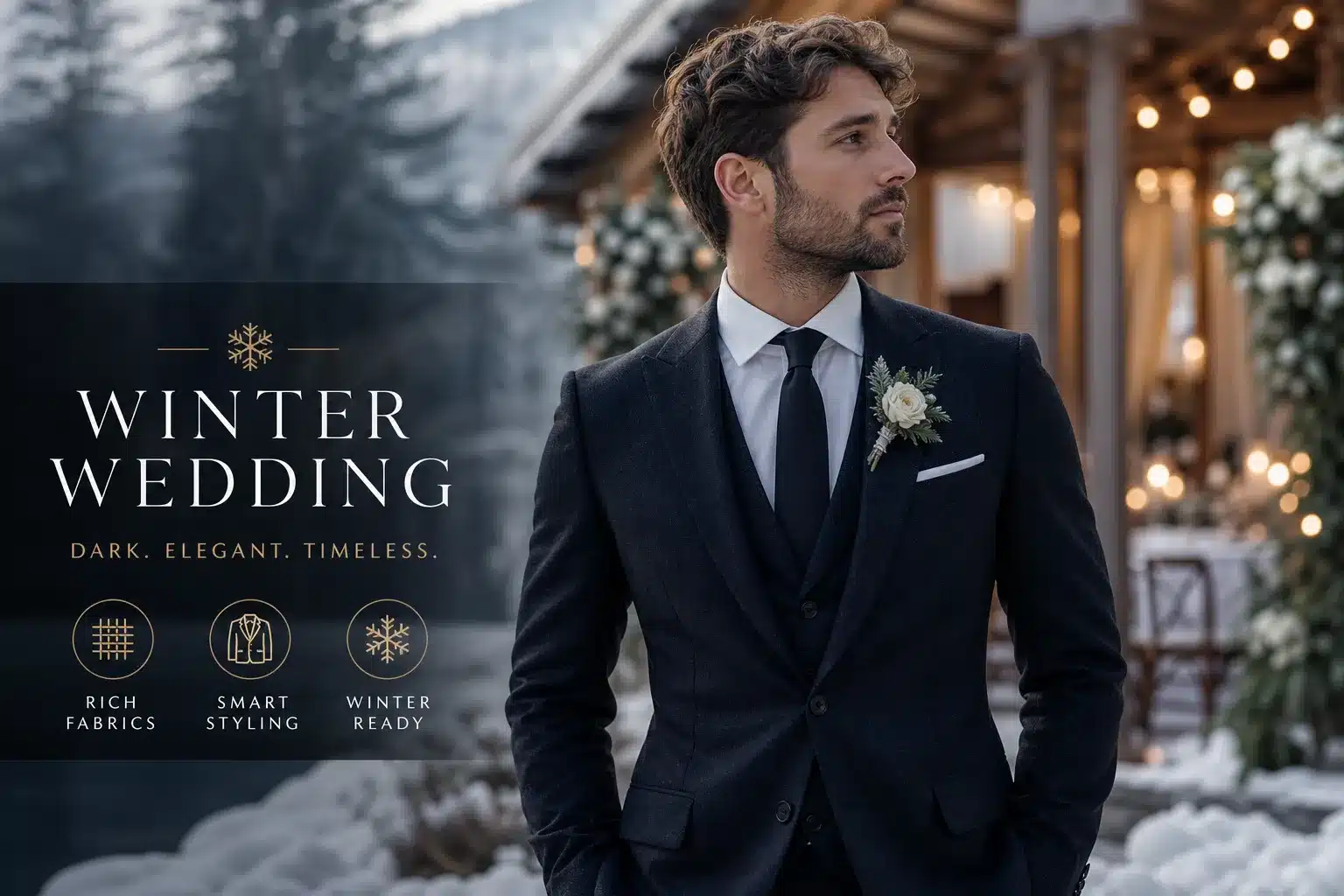
A dark suit for a winter wedding is not a compromise or a safe default, it is the strongest, most seasonally appropriate choice a man can make. Winter is the one season where a well-cut dark suit needs no justification; the occasion does the talking. For decades, Gabucci Menswear Bath has been dressing grooms, groomsmen, and wedding guests, and in that time we’ve watched the winter wedding become the most rewarding occasion in the menswear calendar. The cold months bring venue candlelight, rich colour palettes, and a natural permission to wear heavier fabrics and deeper tones that summer simply won’t support.
This guide covers everything you need to make a considered decision about your dark suit winter wedding look: which colours work best, which fabrics deliver real warmth without sacrificing formality, how to layer without destroying your silhouette, and how to finish with accessories that earn their place.
Dark tones align naturally with winter light in a way that lighter suits simply cannot. A pale grey or medium-blue suit can look washed out under overcast skies and indoor church lighting; many photographers and stylists find that a well-cut navy or charcoal suit carries visual weight and comes across as purposeful in almost any winter setting. Navy and charcoal are the safest anchors, working equally well from a midday church ceremony to a candlelit evening reception.
If you want something with more seasonal personality, deep burgundy and forest green offer richness without sliding into novelty. Burgundy sits beautifully in candlelit evening spaces and pairs naturally with winter wedding palettes. Forest green, worn in a heavy flannel or wool, feels grounded and elegant in country venues and historic buildings alike. The key is keeping the tone genuinely deep: mid-range greens or wines look uncertain in winter light, so commit fully.
Wedding photography in winter relies on rich contrasts and complementary tones rather than bright accents. Navy pairs exceptionally well with champagne, silver, and dusty blue; charcoal sits beautifully alongside burgundy and dusty rose; forest green coordinates naturally with ivory and gold. These combinations are worth understanding whether you’re a groom building a wedding party palette or a guest trying to complement the day’s colour scheme without clashing.
The strongest winter pairings: navy with champagne or silver, charcoal with burgundy or dusty rose, and forest green with ivory or gold. Each combination provides enough contrast to look well-judged in photographs while remaining coherent across a full wedding party.
Black suits can project as funereal or over-formal unless the dress code specifically calls for evening black tie. Charcoal delivers the same sense of formality with more visual depth and nuance, and it photographs with far more interest than flat black. Unless you’re attending an explicitly black-tie event, charcoal is the more refined winter choice, a distinction worth making before you reach for what feels like the obvious option.
Heavy wool is the most versatile all-round option for a winter wedding suit. It offers genuine warmth, breathability, and structure, and it holds its shape across a full day of wear, from the ceremony through to the late reception. In navy or charcoal, a heavy wool suit covers virtually every formality level a UK winter wedding presents.
Flannel adds a softer texture and slightly more relaxed warmth, making it ideal for afternoon ceremonies in country houses or village churches. The warmth-to-formality balance in flannel sits at an ideal mid-point: warm enough to feel appropriate for December, structured enough to project as properly dressed. Both fabrics work equally well in dark tones and respond well to in-house tailoring for a precise fit.
Tweed is the warmest option on this list, but also the least formal. It sits beautifully at barn venues and countryside estates, and at outdoor winter ceremonies where genuine insulation matters as much as visual polish. Forest green and earthy brown tweeds are particularly strong in these settings, picking up the natural environment without looking contrived.
Tweed doesn’t translate as well to black-tie evening receptions or urban ballroom weddings. If your winter wedding is a candlelit hotel affair or a formal cathedral ceremony, heavy wool or flannel will serve you better. Save tweed for the occasions where the venue and dress code genuinely suit it.
Velvet is the most visually luxurious winter fabric and is highly appropriate for December weddings and evening receptions. It isn’t the most practically warm option, but its rich surface texture projects as unmistakably seasonal and formal. Deep navy or midnight velvet paired with peak lapels and minimal accessories makes for one of the most memorable winter wedding looks a man can put together.
Restrict velvet to evening receptions and festive late-year weddings rather than daytime or outdoor ceremonies. In those settings, the fabric looks exactly right. In a muddy churchyard at noon, it looks like a misjudgement.
A merino wool or silk undershirt is the most effective hidden warm layer you can wear. It sits close to the body, adds genuine warmth, and remains completely invisible under a dress shirt. When choosing one, look for a lightweight or mid-weight option with a low crew or V-neckline so it won’t show above the collar, and prioritise a wool-silk or pure merino blend for the best warmth-to-bulk ratio. Thick cotton undershirts, by contrast, create visible collar bunching and distort the jacket shoulder, which defeats the purpose of wearing a well-cut suit entirely.
The waistcoat is the single best formal warm layer for a wedding. It adds core warmth, completes the three-piece look, and means you’re not trapped in your jacket all day to stay warm. A matching waistcoat in the same cloth creates a clean, traditional three-piece; a complementary fabric, such as a subtle check wool against a plain flannel suit, adds visual interest without chaos.
For dark suits, the most effective waistcoat contrast colours in winter are burgundy, forest green, and light grey. A burgundy velvet waistcoat against a charcoal wool suit, for example, is a combination that looks purposeful and seasonally appropriate rather than mismatched. Lapel waistcoats push the formality further and pair particularly well with peak-lapel suit jackets at formal or evening weddings.
The Chesterfield coat and the knee-length wool overcoat are the two strongest winter options over a dark suit. Both should cover the hem of your suit jacket to maintain correct formal proportions. Camel against navy or charcoal is a reliable and highly photographable combination; charcoal-on-charcoal is the safer, lower-contrast option for formal evening settings.
On lapel styles: notch lapels are appropriate for semi-formal winter weddings, while peak lapels carry more authority and are the better choice for formal ceremonies and evening events. For footwear, black cap-toe Oxfords remain the standard. In genuinely wet or snowy conditions, sleek black Chelsea boots in polished leather are a practical alternative that still comes across as appropriately dressed. Avoid suede in any form during UK winter, it marks too easily in rain.
Wool ties and heavy silk ties are more appropriate for winter than lightweight silk. The texture feels more seasonal, and the knot holds better in cold conditions. The strongest tie colours against dark winter suits are burgundy, forest green, midnight blue, and rich gold, each one pulls warmth into the outfit without competing with the suit itself.
A white linen pocket square is always correct and formal. A deeper-toned silk square in a muted burgundy, forest green, or midnight blue adds warmth and coordination. Avoid matching your tie and pocket square exactly; a matching set reads as a costume rather than considered dressing. Instead, pick up a colour from the tie in the fabric of the pocket square, or vice versa.
Darker metals suit winter formality well. Gunmetal, brushed silver, and navy enamel cufflinks come across as more refined than brightly polished gold at a winter wedding. For boutonnières, winter greenery, berries, and evergreen sprigs feel seasonal without overpowering the suit, and they sit naturally against dark wool or tweed lapels.
Between the ceremony and reception, a cashmere scarf worn outside the suit jacket and lined leather gloves complete the look without interfering with your silhouette underneath. Keep the scarf draped cleanly rather than bundled around the collar, the goal is to look considered on the walk between venues, not as though you’re battling a blizzard.
For black tie optional, move toward velvet or a very fine wool suit, peak lapels, and a white dress shirt with a silk tie or bow tie. A waistcoat works here in place of a cummerbund for most suit-based formal looks. For straight formal, a three-piece navy or charcoal suit in heavy wool or flannel covers all bases confidently without overreaching into tuxedo territory.
At semi-formal winter weddings, navy and charcoal suits remain strong choices, but accessories can do considerably more work. A bolder tie colour, a textured pocket square, or distinctive cufflinks give individual character without disrupting the overall scheme. For grooms distinguishing themselves from their wedding party, consider a different lapel style, peak on the groom against notch on the groomsmen, a complementary colour distinction such as charcoal against navy, or a unique fabric like a velvet jacket for the groom against flannel for the party. The goal is to coordinate rather than match, and to create a hierarchy that’s visible in photographs without looking like a considered costume.
Hire suits in the UK typically cost between £80 and £250 for a full package, while buying a quality suit runs from around £300 upward, though off-the-peg options start lower and bespoke tailoring can rise considerably higher depending on fabric and construction. The financial case for hiring appears straightforward until you consider what you actually receive: hire suits are rarely made in heavier wool or flannel, fit is generic, and the quality ceiling is limited by the economics of shared garments.
For wedding guests especially, buying a dark wool or charcoal suit is an investment that pays back across years. A well-made, properly fitted dark suit serves with equal confidence for weddings, professional occasions, and formal evening events. One suit, fitted correctly, earns its cost many times over across a decade of use. Hiring is the sensible choice only if you have no expectation of wearing a formal suit again.
At Gabucci Menswear Bath on Milsom Street, our team specialises in wedding outfit coordination for grooms, groomsmen, and fathers of the wedding party. We carry premium wool, flannel, and tweed options from European designers alongside a range of accessories to complete any winter wedding look. There is no time pressure: walk in or book an appointment, and you’ll leave with a complete look rather than a suit and a list of problems to solve elsewhere.
For those who want a precise fit, bespoke and made-to-measure options are available across a wide variety of fabrics, colours, and weights. Whether you’re dressing for a formal December ceremony in Bath or a country house wedding in the Cotswolds, get in touch with our team to discuss your requirements, or browse our wedding edit online to begin planning your look.
Winter rewards men who dress with intention. A well-cut charcoal flannel suit, properly fitted and finished with a wool tie and a clean white pocket square, will outlast any trend and serve the occasion completely. That is the standard worth aiming for.
The key decisions resolve clearly once you understand the logic: settle on your colour based on venue lighting and the wedding palette, select your fabric based on how much warmth and formality the occasion requires, and add a waistcoat for the most effective and elegant layering. From there, accessories chosen for texture and tone rather than novelty will bring the whole look together. A dark suit winter wedding look, done well, is not merely appropriate, it is the most coherent and considered choice the season offers. Gabucci Menswear Bath is here to help you get it right.