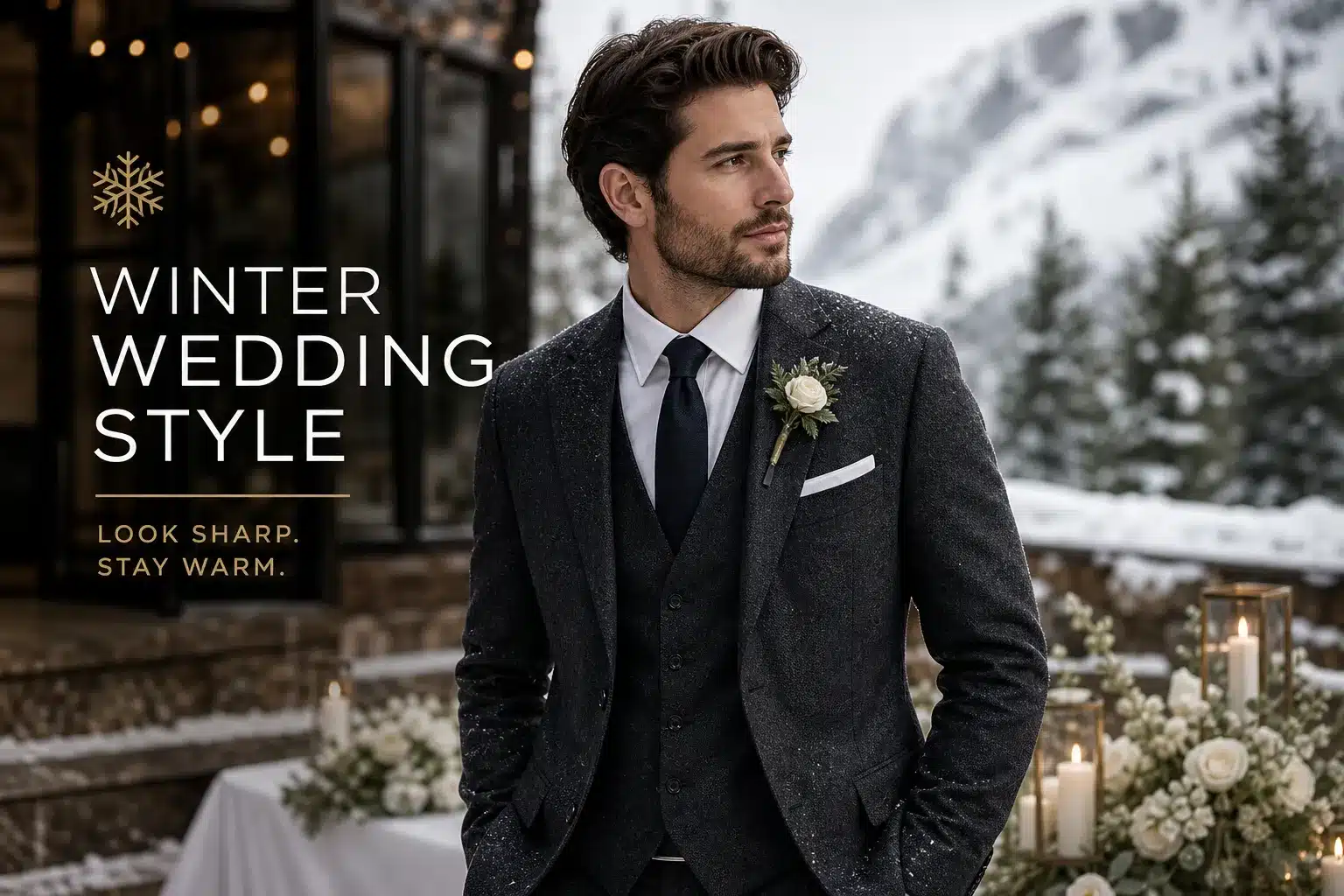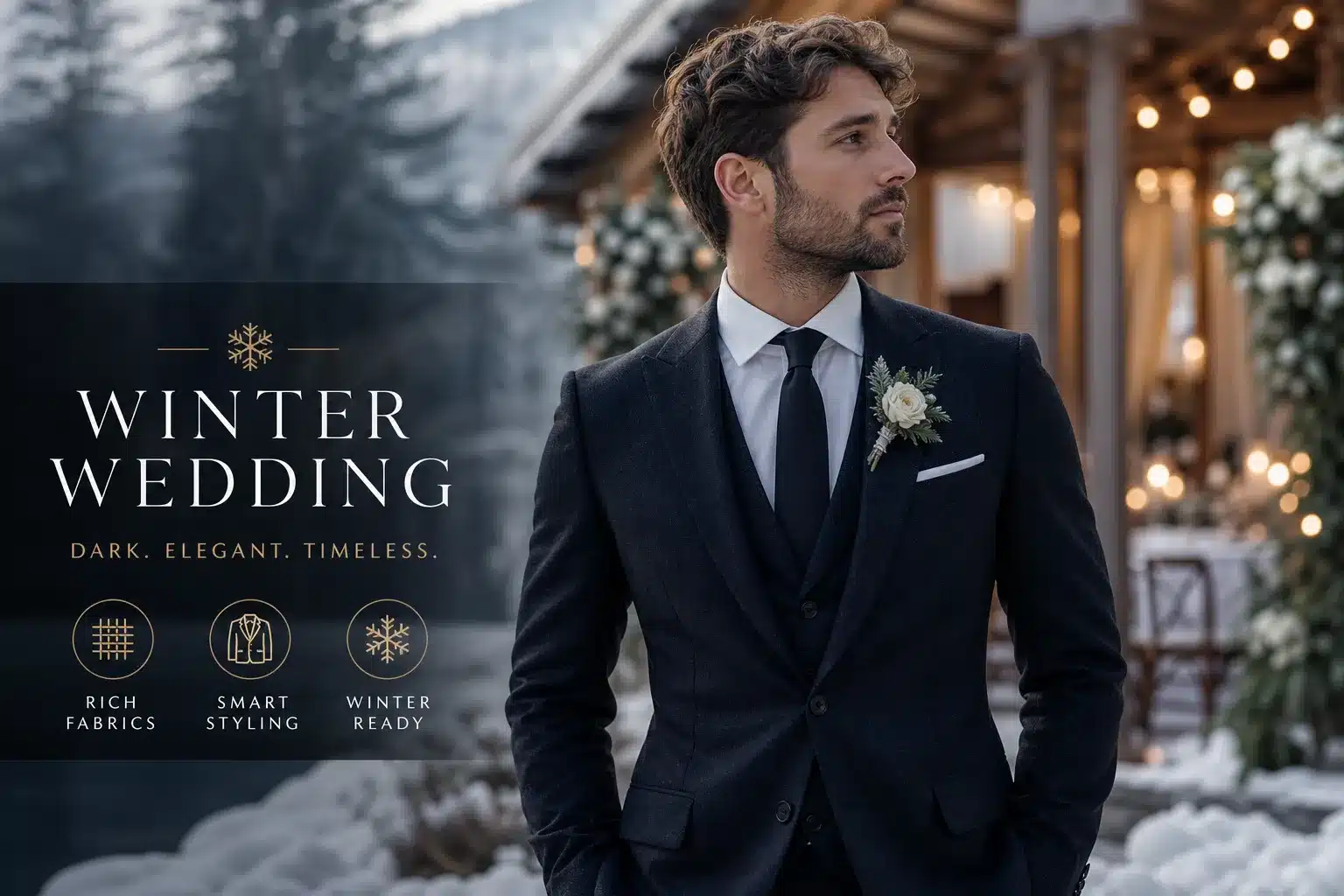
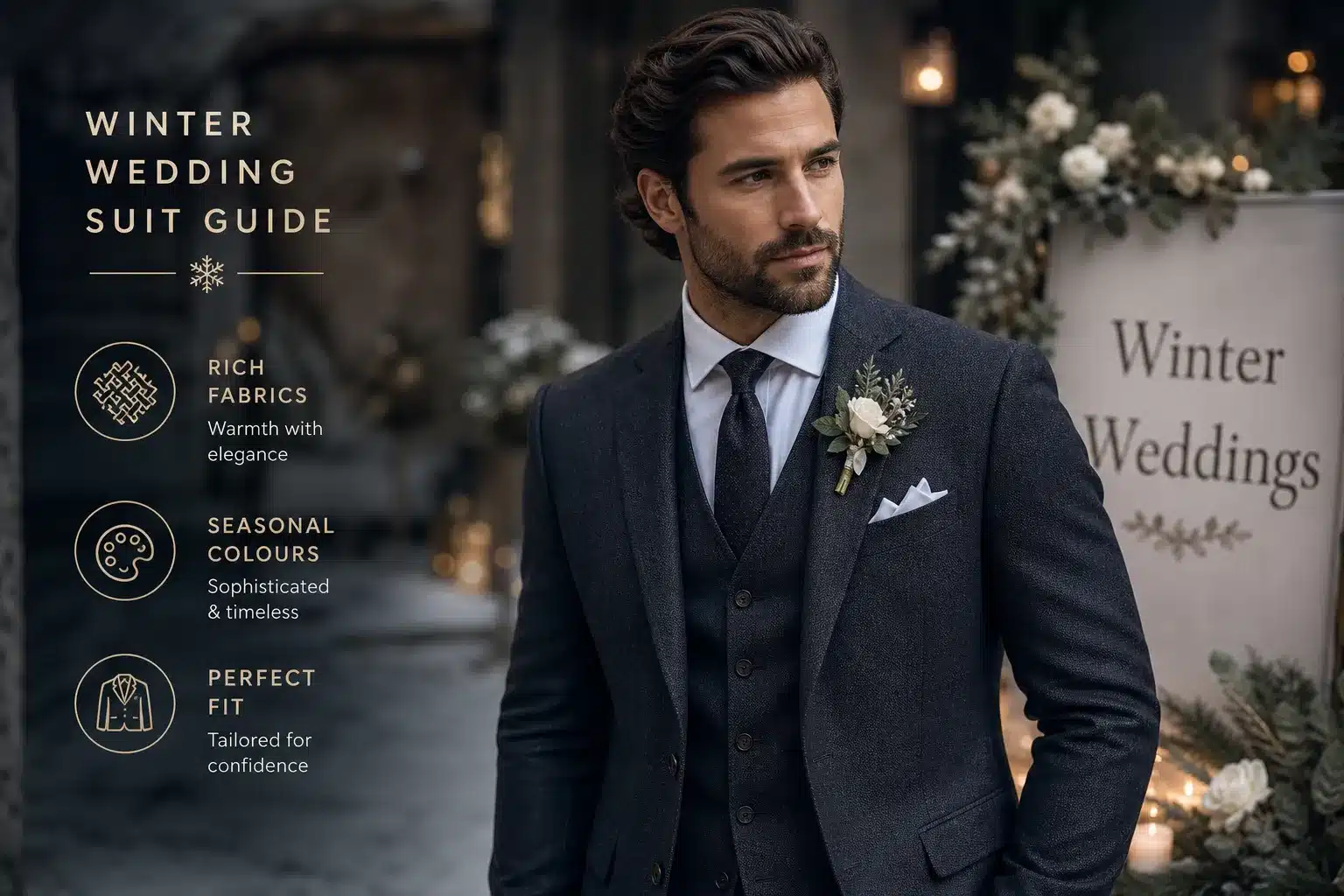
Men’s winter wedding suits demand a different kind of thinking than a summer one. The stakes are higher because you’re balancing warmth, formality, and sharp tailoring in a single outfit, and the margin for error is smaller. Choose the wrong fabric and you’ll spend the ceremony shivering; choose the wrong colour and those low-light winter photographs will follow you for years. At Gabucci Menswear Bath, we’ve been dressing grooms and wedding parties from our Milsom Street boutique for several decades, and the cold-weather wedding is a challenge we understand thoroughly. This guide takes you through every decision, from the cloth on the cutting table to the final fitting room appointment.
Whether you’re a groom searching for a men’s winter wedding suit that works across a candlelit church ceremony and a long evening reception, or a guest trying to strike the right note without looking underdressed, the principles are the same. The principles are consistent: choose your fabric based on venue and weather, build your colour around winter light, layer intelligently, and never underestimate the fitting.
Not every suit cloth handles a cold-weather ceremony well. Understanding the practical differences between wool, flannel, tweed, and velvet is what separates a genuinely comfortable winter wedding suit from one that looks the part on the hanger but fails in the room.
High-quality pure wool and flannel sit at the centre of winter tailoring for good reason. A wool wedding suit built from mid-to-heavyweight worsted cloth, around 280 to 340 GSM, offers breathability that synthetic blends simply cannot match, and it holds a pressed silhouette through an entire long day without sagging or creasing at the elbows. Flannel, with its soft brushed surface and fluid drape, delivers the most polished and refined look of all the cold-weather cloths. It reads as classic formal tailoring rather than country weekend, which makes it the strongest choice for church ceremonies, registry offices, and smart hotel venues.
Wool blends, which introduce polyester or viscose alongside the natural fibre, are more affordable and often more wrinkle-resistant. They’re a sensible choice for grooms on a tighter budget, but they sacrifice some warmth and that natural, living quality that pure wool has against the skin. If budget allows, pure wool or a wool-cashmere blend is worth the investment for a suit you’ll wear more than once.
Tweed is the warmest of the three core options, and the most visually distinct. A men’s tweed wedding suit is exceptional for countryside barns, outdoor ceremonies, and rustic venues where the setting calls for something with heritage and character. Herringbone and Donegal tweeds are particularly well-suited to winter, offering visual interest through weave and fleck rather than colour alone. The caveat is formality: tweed reads as more relaxed and rural, which means it isn’t the natural choice for black-tie events or smart city evening receptions.
For grooms who want something richer and more distinctive, particularly for an evening reception or a black-tie event, velvet makes a compelling case. Its depth of colour and the way it catches candlelight gives it a warmth that goes beyond fabric weight alone. Velvet works best in jewel tones: midnight navy, deep burgundy, or forest green rather than neutrals. It is a confident choice and, worn well, genuinely striking.
Fabric and colour are deeply connected decisions. The richest winter tones tend to look their best in heavier cloths, and choosing one without thinking about the other is where many grooms go wrong. These aren’t rigid rules, but they are the combinations that an experienced eye consistently relies on in cold-weather light.
Midnight navy and charcoal grey remain the strongest starting points for a winter wedding suit for men. Both colours photograph exceptionally well in low winter light, where paler tones can wash out entirely. They coordinate easily with a wide range of shirt and tie combinations, and they read as simultaneously formal and contemporary. Charcoal in flannel or fine wool is particularly at home in a church or registry office setting, while midnight navy in a heavier worsted cloth carries through comfortably into an evening reception.
Beyond the classics, deep burgundy, forest green, and chocolate brown are increasingly popular colour choices for UK winter weddings in 2026. They offer a warmer, more distinctive look without straying into costume territory, and they photograph beautifully against bare winter landscapes and candlelit interiors. These are editorial recommendations based on experience rather than rigid rules, but they are well-established pairings. Burgundy works naturally with a cream or ivory dress shirt, a grenadine tie in deep gold or navy, and tan or oxblood leather shoes. Forest green sits well alongside a white or pale blue shirt, a dark knitted wool tie, and brown leather brogues. Chocolate brown suits a warm ivory shirt and a rust or burnt orange pocket square for a look that feels both seasonal and deliberate.
For grooms who want to look visually distinct from their groomsmen without reaching for a bold colour, texture is the answer. A herringbone weave, a subtle overcheck, or the soft nap of flannel creates depth and interest within a classic navy or charcoal palette. This approach keeps the overall colour scheme cohesive while giving the groom’s suit a character of its own.
Good winter wedding layering is built on one principle: slim, well-fitted additions that add insulation without adding bulk. Every layer should be assessed not just for warmth but for what it does to the jacket’s fit when everything is worn together.
Start with a well-fitted dress shirt in a crisp, well-constructed cotton or poplin, which keeps the collar clean and structured under a waistcoat throughout the day. The tie is where winter texture can do quiet, elegant work: a herringbone silk, a wool knitted tie, or a tie with a subtle jacquard pattern adds depth at the neck without any additional weight. Stick to darker, richer shades that complement the season.
A waistcoat is the single most effective addition for a winter wedding. It provides genuine core warmth through the torso, it makes the overall look more formal than a two-piece alone, and it gives the groom the freedom to remove his jacket during the reception without looking underdressed. A three-piece winter wedding suit worn this way is both practical and sharp. The waistcoat must fit correctly to do its job: close to the body, with no fabric pulling across the chest, no bunching at the waist, and the bottom button left undone as tailoring convention dictates. An ill-fitting waistcoat creates bulk rather than eliminating it, so it should be part of the fitting process from the start, not an afterthought.
A tailored wool overcoat is the natural choice for outdoor moments: photographs outside the venue, the walk from car to church, the departure at the end of the evening. It should be long enough to cover the jacket, roomy enough in the shoulder not to compress the suit beneath it, and removed as soon as you’re inside. Thicker wool or over-the-calf dress socks provide meaningful warmth at the ankle without any visible change to the silhouette. Polished leather shoes or leather-soled boots with grip are far more appropriate than lightweight summer styles. A wool scarf and leather gloves for travel complete the picture, but both come off before the ceremony.
The buy-versus-hire question deserves a direct answer. Wedding suit hire in the UK is cheaper upfront if you’re certain you won’t wear the suit again, but buying almost always delivers a better result for a cold-weather wedding. Here is why that matters in practice.
The UK market currently breaks down roughly as follows. Hire packages range from around £35 to £80 at the budget end, rising to £150 to £300 or more for a premium full package including shirt and accessories. Buying off-the-rack sits at around £150 to £500 for the suit alone, with the complete look including shirt, tie, shoes, and accessories typically landing somewhere between £400 and £800. Made-to-measure and bespoke tailoring starts at around £700 and can reach £1,500 or more depending on cloth and tailoring level, with fully bespoke commissions often beginning above that figure. Prices vary by maker and region, so it’s worth consulting directly with your tailor for an accurate quote.
Hire suits are rarely cut from the heavier winter-weight fabrics that make cold-weather dressing genuinely comfortable. A groom who wants traceable wool, a proper lining, and a silhouette built to accommodate a waistcoat and a thicker shirt underneath is almost always better served buying. The reuse argument is also worth taking seriously: a quality wool or flannel suit purchased for the wedding has an easy second life as a professional or occasion suit, and the cost per wear drops considerably when it’s worn regularly. Buying is the smarter long-term investment at any budget level above the most basic hire package.
The best fabric choice and the most considered colour decision count for very little without the right fit. This is especially true for men’s winter wedding suits, because heavier cloths require more precise adjustment than their lightweight summer counterparts. A flannel or tweed suit that fits correctly looks exceptional. The same cloth hanging or pulling looks heavy and shapeless. The fitting is not the final step in the process; it is the whole point of it.
For a made-to-measure suit, book your first appointment eight to twelve weeks before the wedding date, allowing four to six weeks for the suit to be made and two to three weeks for final alterations. For a fully bespoke commission, four to six months is the minimum, six months is safer if you’re working with a tailor during peak wedding season. If you’re also coordinating suits for a best man, groomsmen, or fathers of the wedding party, start earlier still, because multiple fittings across different body shapes take considerably more time to align than a single commission.
A made-to-measure winter wedding suit is built around the complete layered look. The tailor accounts for the additional depth a waistcoat adds across the chest, the slightly longer sleeve length needed over a thicker shirt cuff, and the way a heavier cloth sits differently at the shoulder and lapel compared with a lightweight summer cloth. Off-the-peg simply cannot make these adjustments because it starts from an averaged template rather than your actual measurements.
At Gabucci on Milsom Street, this is exactly how the process works. The team builds each men’s winter wedding suit around the wearer’s complete layered look rather than fitting the jacket in isolation. Bespoke wool suits are made to order across a wide range of cloths and colours, and appointments are relaxed and unhurried. Booking ahead ensures you receive the time and attention a proper fitting deserves.
The decisions in this guide build on each other. Choose your fabric first, based on venue type and how much of the day will be spent outdoors. Let the fabric guide your colour choice, keeping in mind how that combination will read in winter light and in photographs. Layer deliberately, using a waistcoat as your primary insulation layer and a tailored overcoat for outdoor moments. Treat the fitting as the most important appointment in the whole process, not a box to tick at the end.
For grooms planning a UK winter wedding, the combination of a heavyweight wool or flannel suit in charcoal, midnight navy, or a deep jewel tone, tailored to accommodate proper layering, is the surest route to looking composed and comfortable throughout the entire day. Men’s winter wedding suits done well come down to considered choices in fabric, colour, and fit, with each decision reinforcing the others.
If you’d like to talk through the options in person, the team at Gabucci Menswear Bath are ready to help. Book a fitting appointment or come in and explore the cloth books at our Milsom Street boutique. A suit worth wearing deserves a fitting room worth taking your time in.