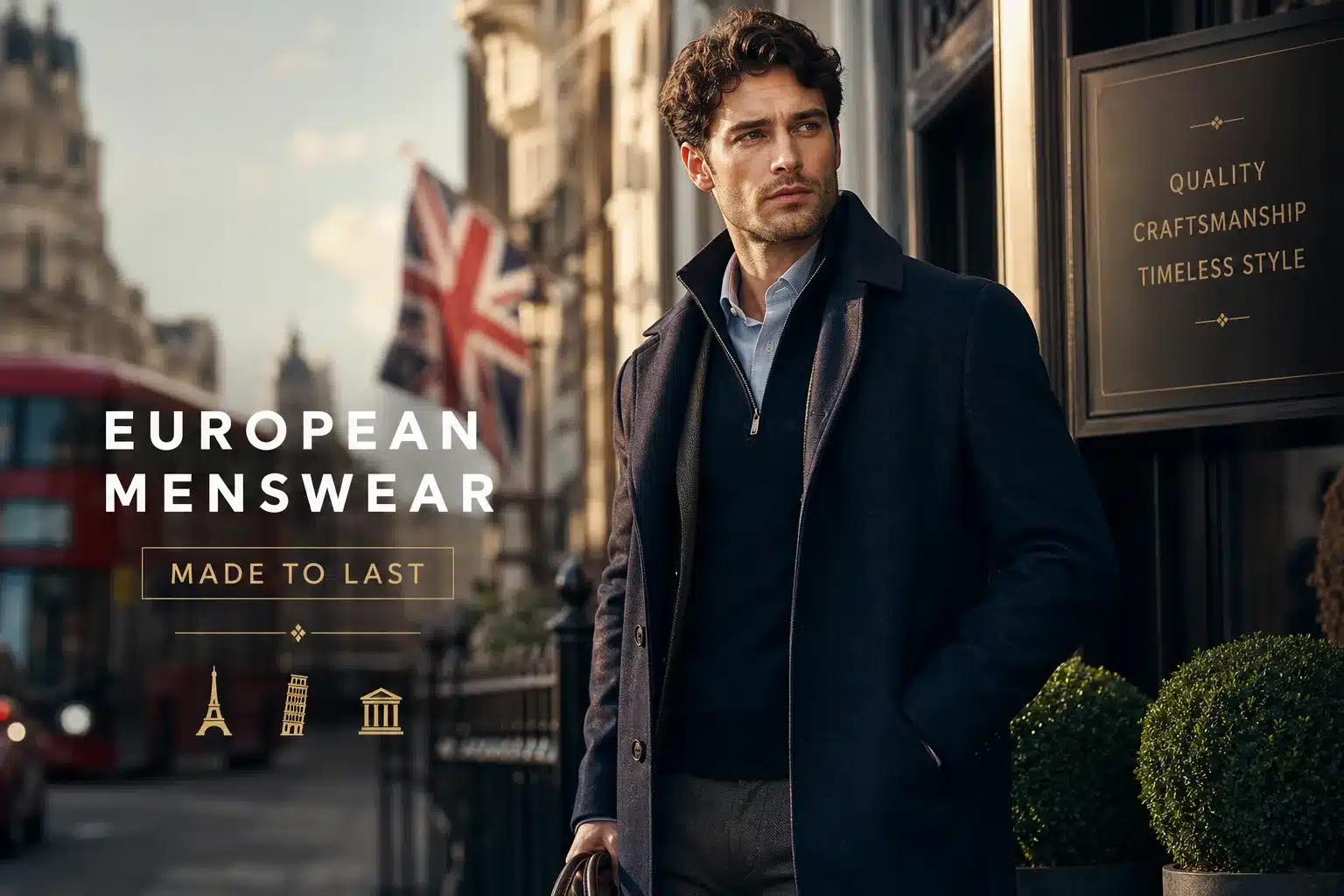
European menswear brands in the UK represent some of the most beautifully constructed, thoughtfully designed clothing available to British men, yet very little of it reaches mainstream retail. Walk down any high street, scroll through any menswear feed, and you’ll see the same names cycling through the same seasonal collections. Many UK shoppers gravitate towards a narrow set of familiar brands without realising that the continent offers genuine alternatives that are more accessible than they might expect. The gap isn’t one of availability. It’s one of knowledge.
Independent boutiques have been solving this problem quietly for decades. At Gabucci Menswear on Milsom Street in Bath, the buying team has spent nearly 35 years seeking out European labels that offer genuine alternatives to generic department store fare: Italian shirts with real character, Portuguese tailoring with considered fabric selection, Dutch design that sits effortlessly in a British wardrobe. While high streets cycle through trend-led product, these boutiques build relationships with makers.
What follows is a guide to the European menswear labels genuinely worth your attention: what each one makes, who it suits, and where you can find it in the UK.
European garment production has a measurable advantage over volume manufacturing elsewhere, and it comes down to specifics rather than sentiment. Northern Italy has a long-standing reputation for shirts cut from Albini-milled fabrics, a mill widely regarded in the trade for its cloth quality, with construction standards that hold their shape through repeated washing. Portugal’s Minho Valley is recognised across the industry as a centre of quality knitwear production, where traditional circular knitting machines create a consistency of gauge that fast-fashion manufacturing rarely approaches. Scandinavian outerwear brands, meanwhile, work with natural fibres selected for performance across seasons rather than cost-per-unit economics.
Pattern matching at seams, the weight and drape of unlined jacket fronts, the finish on a buttonhole: these are the details that separate a garment you’ll wear for a decade from one you’ll replace in two years. “European made” is not a marketing flourish. It’s a measurable set of construction decisions that show up every time you put the garment on.
As a general guide based on typical stockist pricing, quality Italian knitwear tends to fall in the £80 to £150 range, well-constructed European shirting from £120 to £250, and tailored pieces built from traceable cloth from £400 upwards. These figures reflect production provenance and fabric grade rather than brand prestige. In our buying experience, a shirt at £180 from a small Italian label will typically outlast its cheaper counterparts from volume retailers, not just in terms of durability, but in how it wears, how it holds its colour, and how it feels after extended use. The price-per-wear calculation usually favours the European label decisively.
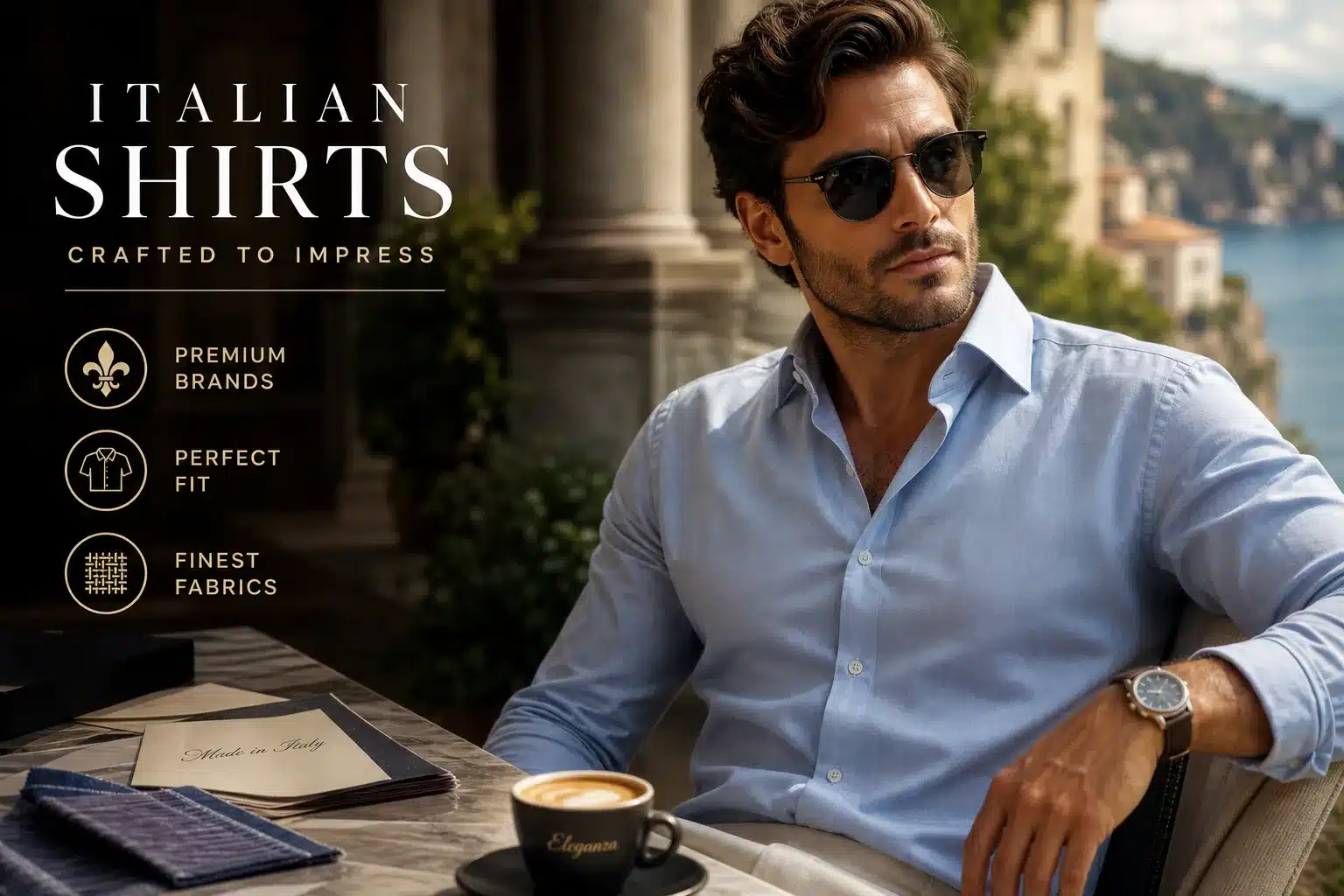
Claudio Lugli is one of Italy’s most distinctive ready-to-wear shirt propositions, and one of the most difficult to find through conventional retail channels. The brand’s design work originates in a London studio, where each print begins as a hand-drawn concept before being refined and applied to premium satin-cotton fabric in limited runs. The result is a shirt that carries genuine narrative: race motifs, sugar skulls, considered animal prints, and graphic references rendered in high-definition colour with contrast panels and sharp cutting.
The fit is generous enough to work across a range of builds, and the quality of the fabric means the shirts hold their shape well after repeated wear. Claudio Lugli rarely surfaces in department stores or mainstream online multibrand retailers. It tends to be found in carefully chosen independents, and at Gabucci Menswear in Bath it has been a long-standing part of the buying selection precisely because it delivers something genuinely different from anything else in the shirt market.
Lacuzzo represents the Italian approach to accessible suiting: refined construction, considered fabric selection, and a silhouette that moves away from the rigid structure of high-street tailoring without abandoning formality. For men stepping away from off-the-peg suiting for the first time, Lacuzzo offers a natural entry point into European tailoring values without requiring a bespoke budget. The brand performs particularly well in lightweight wools and blended fabrics well suited to the British climate, occupying a position that bridges continental tailoring and everyday wearability.
Italian labels tend to excel in shirting, knitwear, lightweight suiting, and unstructured outerwear. If your wardrobe is already well served in trousers and footwear, the Italian label that will make the most immediate difference is almost always a shirt or a merino knit, pieces where Italian fabric knowledge and construction finesse are most legible to the wearer and where the investment justifies itself quickly through quality of wear.
Scandinavian menswear is built on restraint: material honesty, considered colour palettes, and a preference for pieces that age well rather than trend-chase. This maps closely onto the classic British wardrobe ideal, which explains why Nordic labels have built such strong followings among UK men without heavy marketing. A Danish overshirt in organic wool or a Swedish jersey in a considered neutral doesn’t announce itself. It simply works, week after week, season after season.
Samsøe Samsøe, the Danish label, is a certified B Corp that labels each product with its carbon footprint as part of its transparency commitments. It has over 65 UK stockists, including Selfridges, and operates its own direct-to-consumer site. The brand makes clean, considered pieces across knitwear, outerwear, and casual suiting, and it suits men who want understated quality without paying luxury prices.
CDLP, the Swedish label, focuses on responsibly produced wardrobe basics, particularly underwear and loungewear, made in Europe with a strong sustainability commitment. mfpen, from Denmark, works with GOTS-certified organic cotton and recycled fibres, producing relaxed tailoring and casual separates that sit easily in a minimal British wardrobe. Both ship directly to the UK.
Lacoste needs little introduction on British high streets, where its polo heritage and sportswear range are widely stocked through independents and national retailers alike. For men wanting something more editorial, A.P.C. from Paris offers Parisian minimalism in carefully cut denim, outerwear, and accessories, available via select international retailers and the brand’s own online channels. The brand is understated to the point of severity, which makes it a natural complement to bolder European pieces.
Spain’s most compelling sustainable menswear contribution is Ecoalf, a brand that builds its entire output from recycled materials, including ocean-collected plastics converted into yarn and fabric through its “Upcycling the Oceans” programme. Ecoalf holds B Corp certification and carries a strong track record of transparency around supply chain provenance. For men who want their wardrobe choices to reflect a genuine environmental position, it is one of the few European men’s fashion brands to substantiate its claims with verifiable data.
R2 is a Dutch-designed menswear label whose construction draws heavily on Portuguese and Italian fabric traditions. Founded in Amsterdam in 2008, the brand built its reputation on shirts with considered detailing and a Mediterranean ease in the cut, before expanding into knitwear, polos, and overshirts. Premium R2 pieces use Italian Albini fabrics, which accounts for the quality of drape that distinguishes them from comparable labels at similar price points.
R2 is available in the UK through a small number of independent boutiques, including Gabucci Menswear Bath, where the buying team has championed the label for the quality of its construction and its distinctive position between relaxed tailoring and confident casualwear. It’s the kind of brand that rarely makes a shortlist until you own a piece, at which point it tends to become a fixture in how you dress.
There is a meaningful difference between brands that manufacture in Europe and those that simply design there. Italy remains the benchmark for luxury shirting and suiting production. Portugal’s garment industry, particularly in the Minho Valley, is the dominant force in quality knitwear and denim for European labels that take provenance seriously. Scandinavia produces outerwear and basics with a strong record of natural fibre sourcing and responsible production practices.
When assessing a brand’s provenance claims, look for named production facilities, country-of-manufacture labelling on the garment itself, and published supply chain transparency reports. Vague language such as “crafted with European inspiration” tells you nothing. A brand genuinely committed to European manufacturing will show you exactly where and by whom.
Several credentials carry genuine weight when you’re evaluating sustainable European menswear brands. GOTS certification confirms that organic textile claims are independently verified across the full supply chain, not just at the raw material stage. B Corp status indicates that a business meets verified standards across environmental and social performance. The ZDHC Roadmap to Zero addresses hazardous substances in manufacturing, relevant particularly for denim and treated outerwear. Circular return programmes, where brands accept and remake worn garments, are rarer but growing. Of the labels covered here, Samsøe Samsøe holds B Corp status and uses carbon labelling; mfpen works with GOTS-certified and recycled fibres; and Ecoalf holds B Corp certification alongside its Upcycling the Oceans programme. Each brand publishes its credentials directly, so it’s worth verifying the specifics before purchasing.
The structural reason that outstanding European labels don’t appear in John Lewis or on ASOS comes down to minimum order quantities, distribution exclusivity, and editorial consistency. Department stores and large online multibrand retailers need volume, which means they favour brands that can supply at scale across multiple seasons without restricting distribution. Independent boutiques operate on a fundamentally different model, one built around selection, relationships with makers, and a buying vision that prioritises distinctiveness over breadth.
Labels like Claudio Lugli, R2, and Lacuzzo choose their stockists with the same care that boutiques use to build their stock. The brands limit their distribution deliberately, and the boutiques seek out labels that genuinely reward the search. The result is a retail environment where the selection means something, where every piece on the rail has been chosen rather than simply ordered.
Gabucci Menswear on Milsom Street in Bath has been curating European designer menswear since the late 1980s, three and a half decades of buying trips, brand relationships, and editorial instinct applied to one of the most carefully chosen floors in British independent retail. The boutique carries labels including Claudio Lugli, R2, Lacuzzo, and a wider selection of European designers chosen for their construction quality, design character, and provenance. The in-house tailoring service means that garments can be adjusted to fit precisely, which is particularly valuable when buying European labels whose sizing conventions don’t always map directly onto British body proportions.
Whether you visit the Milsom Street boutique in person, where the service is unhurried and the knowledge is genuine, or explore the online shop from further afield, the curation is the same. For anyone serious about discovering European men’s fashion brands available in the UK, it is a natural starting point. Browse the current selection at Gabucci Menswear to see the full edit of European labels in stock.
European menswear brands in the UK offer something the high street structurally cannot: craftsmanship rooted in production tradition, fabric quality that reflects genuine investment, and a distinctiveness that doesn’t rely on logo recognition. Italian labels bring fabric character and precision in shirting and lightweight suiting. Scandinavian labels offer restraint, longevity, and credible sustainability credentials. French menswear labels, alongside their Spanish and Portuguese counterparts, round out the picture with heritage, versatility, and some of the most transparent supply chain practices in European fashion.
The practical route into this world is through independent boutiques with the expertise to source and explain these labels properly. Gabucci Menswear Bath has been doing exactly that for several decades. If you want to dress better and understand why, that’s where to begin.