A well-made Italian jumper is one of the most quietly impressive things a man can own. It requires no explanation, holds its shape for years, and pulls together everything from a pair of dark trousers to a sharply cut suit jacket with the kind of effortless authority that no fast-fashion alternative has ever managed to replicate. This isn’t a trend purchase. It’s a wardrobe investment, and once you understand what separates genuinely good Italian knitwear for men from the imitations, the decision becomes straightforward.
Italian knitwear for men spans a wide range of fabrics, silhouettes, and price points. But what connects the best of it is a shared commitment to construction and fibre quality that mass-market alternatives rarely match. At Gabucci Menswear Bath on Milsom Street, Italian knitwear labels like Montechiaro sit alongside the store’s wider European edit, and these tend to be the pieces customers return for season after season, not because they’re fashionable, but because they work.
This guide covers the fabrics, silhouettes, styling principles, and brand landscape that matter most, drawing on 2026 price bands and construction comparisons, so you can make an informed decision about what to look for, what to spend, and why the right piece justifies the investment.
The reputation of Italian knitwear isn’t a marketing construct. It’s rooted in geography and craft tradition that has been building for generations. Understanding where these garments come from, and how they’re made, is the clearest way to understand why the price premium is justified.
Italy’s knitwear industry is centred on a handful of specialist regions. Biella, in Piedmont, is internationally known for premium wools, cashmere, and the fine-fibre yarns that supply the luxury end of the market. Carpi, in Emilia-Romagna, is the heartland of finished knitwear production: a district of family-run workshops and specialist manufacturers that have supplied European menswear houses for decades. These aren’t interchangeable. They represent different stages of the supply chain, and between them, they form the backbone of what “Made in Italy” actually means on a knitwear label.
That last point matters more than most buyers realise. “Made in Italy” means the garment passed through this production network, not simply that it was designed by an Italian. A label that says “Italian design” or “inspired by Italy” carries no such guarantee. When you see genuine Made in Italy credentials backed by a reputable stockist, you’re buying into something specific and verifiable.
Fully fashioned knitwear is shaped on the knitting machine itself, with each panel formed to the contours of the garment before being joined with hand-linked seams. The alternative, cut-and-sewn construction, stitches together pre-cut fabric panels, much like making a T-shirt from jersey fabric. The seams are bulkier, less elastic, and more likely to distort over time.
For the wearer, the difference is tangible. A fully fashioned knit sits cleanly at the shoulder, lies flat against the body, and holds its shape with repeated wear. The hand-linked seam, joined loop by loop to match the knit structure, doesn’t dig into the skin or create that characteristic ridge across the shoulder that cheaper construction leaves behind. It’s a quality marker worth asking about before you buy.
Fabric choice determines warmth, feel, durability, and the appropriate season of wear. Getting this decision right before you buy saves you from owning a jumper you love in theory but reach for only twice a year.
Cashmere offers unmatched softness and warmth for its weight. It’s lighter, warmer, and more luxurious against the skin than most alternatives. The trade-off is that it requires more care and is more prone to pilling, particularly under friction at the elbows and underarms. Extra-fine Merino wool men’s jumpers, by contrast, are springier, more resilient, and hold their shape more consistently with daily use. Merino is the more practical choice for office wear or frequent travel, without sacrificing the refined feel that makes Italian men’s sweaters worth owning in the first place.
The simplest decision framework: reach for cashmere for evenings and occasions; reach for Merino for your everyday rotation. Both sit at the heart of quality Italian knitwear for men, and both represent a meaningful step up from anything produced at mass-market speed and price.
Italian makers also produce excellent spring and summer knitwear in cotton and silk-cotton blends. These are cooler, airier, and well-suited to transitional weather, smart-casual events in warmer months, or compact holiday packing. A fine-gauge Italian cotton crewneck is a genuine warm-weather wardrobe piece, not an afterthought or a compromise.
The drape is noticeably different from Merino, crisper in hand and more structured in fall, and the construction at the better end of the Italian market is just as considered. If your wardrobe is currently weighted toward heavier knits, a cotton or silk-blend piece is a worthwhile addition.
The three classic silhouettes in Italian knitwear each have a distinct use case. Understanding them clearly means you build a collection that actually gets worn, rather than accumulating similar pieces that serve the same purpose.
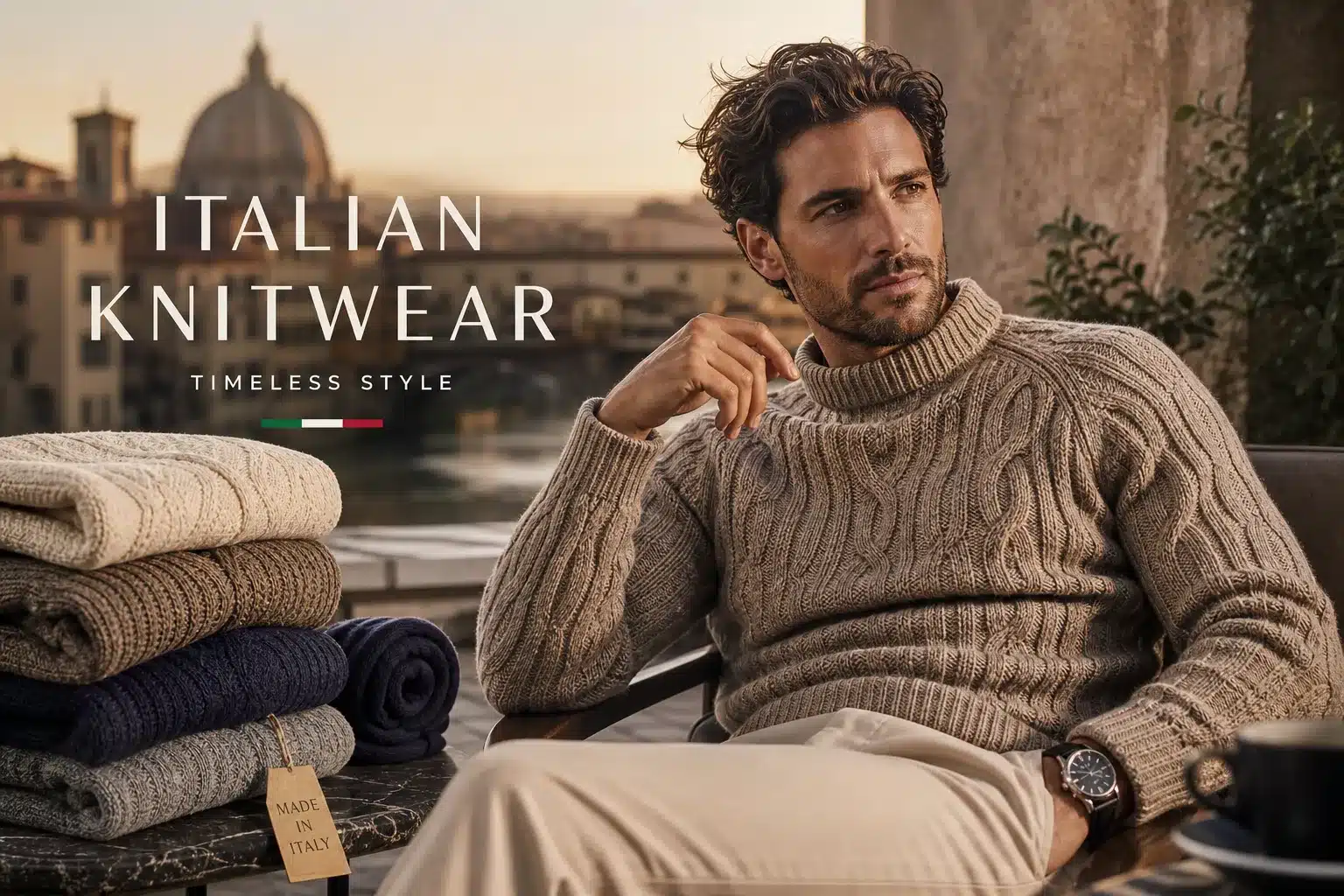
The crewneck is the default starting point for any man building an Italian knitwear collection. It works over a collared shirt for a smart-casual look, on its own with tailored trousers, or under an unlined jacket. Most of the great Italian knitwear brands produce their strongest and deepest range in this silhouette, and it’s the most forgiving across different occasions and body types. If you’re new to the category, a fine-gauge Merino or cashmere crewneck is the first purchase to make.
The V-neck fell out of favour briefly, but it’s firmly back in 2026 menswear, particularly in fine-gauge Merino or cashmere. Its natural use case is over a shirt and tie, where it creates a cleaner layered look than a crewneck and lets the collar and tie read clearly. It also works in a more relaxed setting with an open-collar shirt, where the V creates visual interest without overpowering the rest of the outfit. Italian makers tend to produce V-necks with a shallower, cleaner angle than many mass-market versions, which generally makes them more wearable across both registers, a tendency that holds true across most of the established northern Italian producers.
The roll neck is the most opinionated silhouette of the three. It makes a deliberate choice, and it pays off when worn with confidence. Pair it with a single-breasted jacket or overcoat for a modern, refined alternative to a shirt and tie. It works across smart-casual and formal registers, and it photographs well. The key distinction with Italian-made roll necks in fine cashmere or Merino is the quality of drape: they sit cleanly against the neck rather than adding bulk or forcing an awkward fold. A well-made Italian roll neck is one of the most versatile cold-weather pieces a man can own.
Good knitwear earns its place by being genuinely wearable across different settings, and the following principles apply across most of them.
The most reliable formula: a fine-gauge Italian cashmere or Merino crewneck in navy, charcoal, camel, or olive, paired with well-cut chinos or dark denim, and finished with leather Oxford or Derby shoes. The key is proportion. A more relaxed-fit knit works with a slimmer trouser; a more fitted knit works with a slightly fuller leg. The AW26 preference in Italian and European menswear leans toward relaxed but refined silhouettes, with earth tones and classic colour palettes dominating. Rust, chocolate brown, ivory, and olive are all current. Navy and charcoal remain the most versatile foundations.
Italian knitwear transitions into more formal territory more naturally than most men expect. A roll neck or fine crewneck worn under a suit jacket instead of a shirt is a well-established Continental approach, and it works particularly well with clean, uncluttered colours. The suit fabric matters here: an unstructured linen or wool-mix jacket sits more naturally over a knit than a heavily canvassed formal suit. This is also where the quality of the knit’s construction becomes visible. A fully fashioned Italian piece in fine Merino sits smoothly under a jacket. A cheaper cut-and-sewn alternative tends to bunch at the shoulder and distort across the back.
The Italian knitwear market covers a wide spectrum. Knowing where each brand sits helps you approach the purchase with clarity rather than guesswork.
At the ultra-luxury end, Loro Piana and Brunello Cucinelli produce jumpers from around £800 upwards, with some cashmere and speciality-fibre pieces moving well above that. Established luxury tailoring houses like Zegna and Canali typically sit between £350 and £900, where the focus shifts from pure cashmere prestige toward a more rounded garment with strong construction credentials. (Price bands are based on 2026 sterling equivalents of published European retail figures and may vary by retailer.) At the premium mid-range, labels like Gran Sasso, Luca Faloni, and Artknit Studios sit between £150 and £350 and represent the strongest value proposition in the category. A Gran Sasso Merino wool men’s jumper at around £250 is not a compromise. It is simply a different category of purchase to a Brunello Cucinelli cashmere at £1,500, and it belongs in the same conversation about quality.
Gabucci on Milsom Street in Bath stocks Montechiaro, an Italian knitwear label produced in Montichiari, Brescia, in northern Italy, near Lake Garda. Montechiaro is known for technically complex knitwear construction, including jacquard and intarsia work at gauges that only a small number of manufacturers worldwide are set up to handle, a distinction supported by trade documentation on northern Italian specialist producers. The brand sits in the premium mid-range with a clear focus on fibre quality and construction integrity, which makes it one of the most compelling propositions in the category at its price point. It represents exactly the kind of luxury knitwear Italy does best: considered, durable, and made without shortcuts.
As an independent boutique with close to 35 years of menswear experience, Gabucci offers something that UK department stores and online-only retailers find difficult to replicate: the ability to handle the fabric, assess the construction in person, and receive honest, expert guidance on fit and styling before you commit to a purchase. Montechiaro pieces are available both in-store and online through Gabucci, so this level of access isn’t limited to those who can visit Bath in person. If you’re looking to invest in Italian knitwear for men and want a starting point with genuine authority behind it, the Montechiaro range at Gabucci is a reliable place to begin.
Buying well is only half the equation. Knowing how to check authenticity and extend the life of a fine knit protects the investment you’ve made.
The label must read “Made in Italy.” Not “Italian design,” not “inspired by Italy,” not “Italy collection.” Those phrases carry no provenance guarantee. Construction signals matter too: look for even stitch tension, clean hems, and well-finished ribbing. A reputable stockist should be able to tell you not just the country of origin but the production regionand, ideally, the mill or manufacturer. Buying from an authorised independent stockist like Gabucci greatly reduces the risk of counterfeit goods and vague provenance claims, and if you want additional reassurance, it’s worth cross-referencing with brand authenticity codes or contacting the brand directly. If a seller can’t answer basic questions about where a piece was made and how, treat that as a reason to look elsewhere.
For cashmere and extra-fine Merino, hand washing in cool or lukewarm water with a gentle wool detergent, allowing a brief soak without rubbing or wringing, is the safest approach. If you use a machine, a wool or delicate cycle at low temperature with a low spin is acceptable. After washing, press out excess water with a towel, reshape the garment while damp, and dry it flat, away from direct heat and sunlight. Never hang knitwear on a hanger: this distorts the shoulder and stretches the body out of shape over time.
For storage, always make sure the piece is clean before putting it away for the season. Dirt and body oils attract moths. Store folded, in a well-sealed drawer or box, with cedar or lavender as a deterrent. Avoid long-term storage in plastic bags. A well-cared-for Italian jumper in fine Merino or cashmere can last a decade or longer. That’s the investment mindset the category deserves.
Italian knitwear for men is one of the most considered, long-term wardrobe decisions a man can make, not because it’s expensive, but because the right piece, in the right fabric, worn with a little intention, earns its place in every sense: practically, aesthetically, and financially. The decision framework is straightforward: fabric first, then silhouette, then occasion.
If you’re new to the category or looking to add depth to an existing wardrobe, the Montechiaro collection at Gabucci Menswear Bath is an excellent place to start. Visit the store on Milsom Street in Bath, where the team can walk you through the range in person without time pressure, or explore the collection online. Either way, speaking with the team before you buy is worth the effort. Their guidance on fit, fabric, and styling is part of what the independent boutique experience genuinely offers.