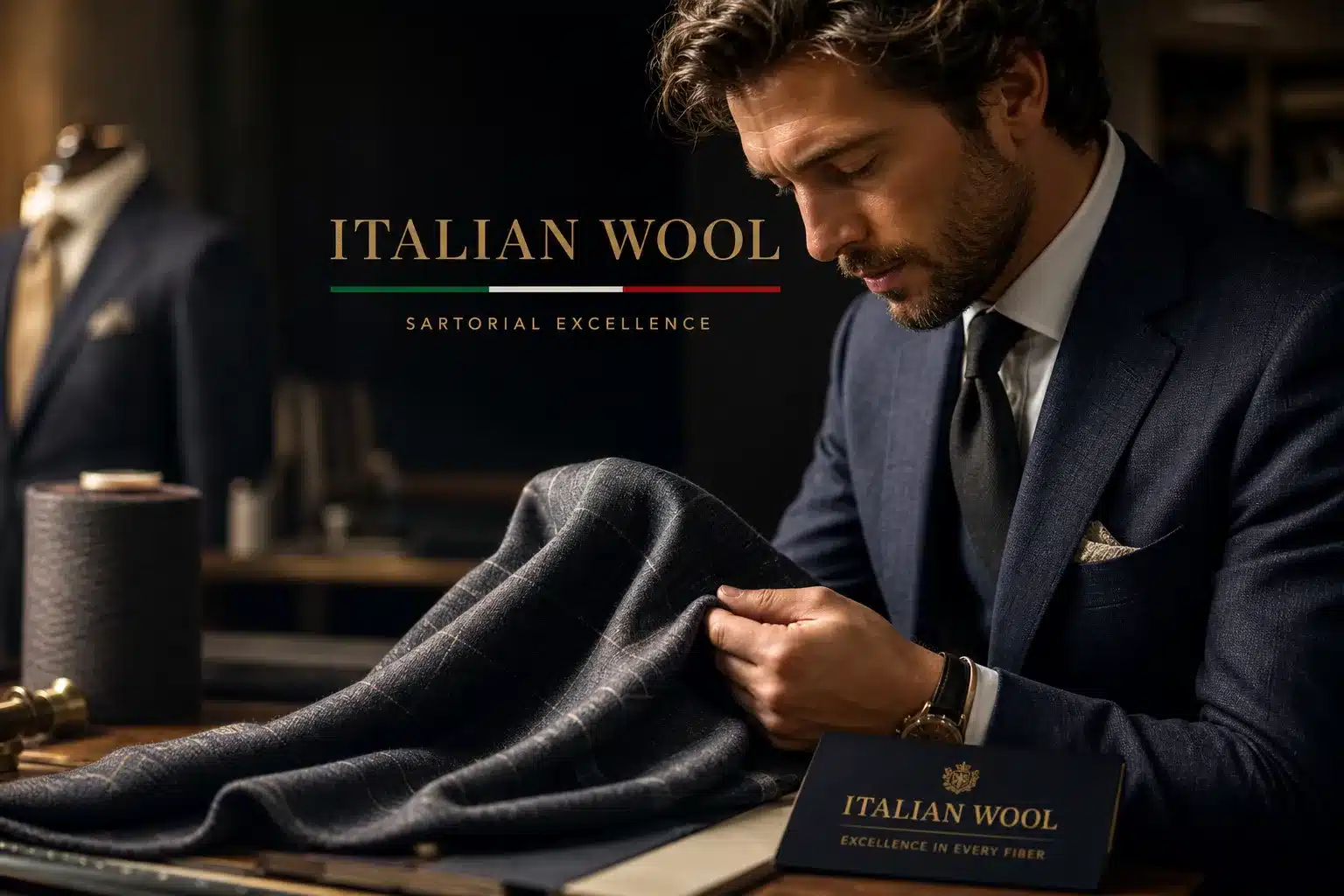
If you have ever worn a suit that felt genuinely alive on the body, light but structured, cool but substantial, the cloth was almost certainly woven in Italy. There is a quality to fine Italian suiting cloth that you recognise immediately and struggle to articulate afterwards: a kind of intelligent drape, a responsiveness to movement, a surface that catches light without demanding attention. That quality is not accidental. It is the product of centuries of accumulated craft, concentrated in one region, refined by competing mills across generations.
This article explains exactly what separates authentic Italian wool from imitation. You will learn which mills produce the most respected suiting fabrics, what the technical labels actually mean for how a suit wears, how to verify what you are buying, and where to find the right cloth in the UK. At Gabucci Menswear Bath on Milsom Street, conversations about fabric choice begin here almost every time a client commissions a bespoke suit. The cloth is where a great suit either starts or fails, and this is where you start making that decision well.
The story of fine wool suiting begins in Biella, a small city in the Piedmont foothills of northern Italy. For several centuries, the mills concentrated in this valley have produced cloth that other regions have attempted to replicate and never quite matched. The soft mountain water flowing through Biella’s rivers proved ideal for finishing delicate fibres without damage, and the cool air created conditions that allowed lengthy drying and setting processes to work properly. These are not romantic details. They are technical advantages that shaped the quality of the finished cloth.
What makes the Biella cluster extraordinary is its vertical integration. Several of the major lanifici, the Italian term for wool mills, control the entire process from raw fibre sourcing through to weaving and finishing under one roof. Loro Piana and Ermenegildo Zegna are well-documented examples of this model, managing in-house spinning, weaving and finishing to a degree that most producers cannot match. That control matters because quality can be maintained at every stage rather than passed between suppliers. A mill that sources its own fibres, determines its own twist levels and oversees its own finishing temperatures produces a fundamentally more consistent cloth than one that assembles processes from separate suppliers.
The concentration of competing mills in one valley drove quality relentlessly upward across generations. Mills like Vitale Barberis Canonico, founded in 1663, and Fratelli Piacenza, established in 1733, are not simply heritage marketing. They represent centuries of accumulated technical refinement, passed through family ownership and long-tenured craftspeople who understand that decisions around fibre selection, twist levels and finishing temperatures require skilled human judgement rather than automated instruction. No other region in the world has replicated this depth of specialist knowledge at this density.
When a tailor presents you with a cloth book, the name on the selvedge tells you more than any description. Understanding the key mills allows you to read those names with genuine intelligence rather than deference. The distinction to grasp first is that a mill produces fabric; a brand or tailor uses it. Most prestigious tailors source their cloth from independent lanifici. Loro Piana and Ermenegildo Zegna are unusual exceptions in that they operate as both mill and finished-garment brand.
Loro Piana’s mastery sits at the finest end of the spectrum, working with Super 130s to Super 180s wools alongside rare fibres including vicuña and cashmere. Their Storm System range adds weather resistance without compromising drape, and their double-faced coated fabrics represent a notable standard for luxury outerwear cloth. Zegna’s Trofeo collection carries a different reputation: valued by tailors for its crease resistance, breathability and year-round durability rather than extreme fineness alone. Both mills are vertically integrated, controlling raw fibre sourcing as well as weaving and finishing, which produces the extraordinary consistency that working tailors rely on when specifying cloth for clients.
Vitale Barberis Canonico is consistently cited as the tailor’s mill of choice across the bespoke trade. Their Super 110s to Super 150s range sits at a price point accessible to skilled independent tailors, and their consistency across dye lots, shrinkage behaviour and long-term wear performance is what builds a tailor’s trust over years of ordering. Reda’s Rewoolution merino range adds a performance dimension with stretch and water resistance, favoured by tailors dressing clients who travel frequently and need a suit that recovers reliably after a long flight. For everyday professional suiting, both mills deliver without requiring the careful handling that the most extreme luxury cloths demand.
When you see “Super 150s” or “17.5 microns” on a cloth book or selvedge, those numbers are telling you something precise and practical about how the suit will feel and wear, what each figure represents, and what it means for the day-to-day behaviour of the cloth.
The Super number is derived directly from fibre diameter. Super 120s corresponds to approximately 17.5 microns; Super 150s drops to around 15.5 microns. The finer the fibre, the silkier the drape and the softer the hand feel against the skin. In practice, Super 110s to Super 120s is the sweet spot for a suit worn regularly in a professional environment. The cloth is soft enough to feel refined, but the fibre is robust enough to hold shape through multiple wearings per week. Super 150s and above is extraordinary to the touch, but best reserved for suits that rotate with others and are not subjected to daily wear. Micron count is the more precise specification; any reputable mill will provide this on request or within their cloth books.
A worsted cloth is tightly combed with parallel fibres, producing a smooth, clean surface that holds a silhouette well and resists surface wear. A twill weave introduces diagonal ribbing, adding drape and visual depth at the cost of some surface hardness. For a suit that needs to perform across a full working week, a plain-weave worsted from VBC in Super 120s is typically more durable than a Super 150s cloth with a looser, more open weave, regardless of fibre quality. The combination of fibre fineness and weave structure determines wearability. Focusing on Super number alone without considering construction gives you only half the picture.
The technical specifications explain quality in abstract terms. What they cannot fully prepare you for is the lived experience of wearing a fine Italian wool suit through a full day. The breathability and natural thermal regulation of the cloth are qualities that genuinely separate it from synthetic-heavy alternatives, and ones you notice continuously rather than just at the moment of putting the suit on.
Wool is temperature-responsive in a way no synthetic fabric can replicate. It absorbs moisture vapour before it becomes sweat. This regulates body temperature passively without any synthetic assistance. Fine Italian merino cloths, particularly high-twist fabrics from mills like Zegna and Reda, achieve this because the fibre structure draws moisture away from the body and releases it externally. This is why a well-made Italian wool suit is genuinely comfortable in both spring and early autumn, not just in winter when insulation is the obvious priority.
The natural crimp in wool fibre creates elasticity at a microscopic level, which is why a suit hung overnight recovers its line after a full day’s wear. High-twist worsted cloths are particularly resistant to knee-bagging and seat-shine, the two most visible signs of a suit that has been worn past its structural life. A cloth from VBC or Reda, properly made and rotated with at least one other suit, can perform well for many years with correct rotation and care, a claim you simply cannot make for most synthetic alternatives.
UK retailers stocking genuine Italian wool cloth offer a wide range of price points. Entry-level fabrics can begin from around £16 per metre, with 100% virgin wool commonly falling between £25 and £45 per metre depending on weight and construction. Premium cloths from named lanifici such as Loro Piana or Vitale Barberis Canonico typically sit between £45 and £90 per metre, while luxury wool-cashmere coating fabrics can reach £95 to £100 per metre or beyond, reflecting fibre content and finishing complexity. These are reference points rather than fixed rules; remnant and deadstock fabrics from authorised dealers can offer significant reductions, though you lose consistency across a full commission.
Buying fabric by the metre suits experienced home tailors and makers who know how to work with fine cloth. For anyone commissioning a tailored suit, the more practical route is working with a specialist who already sources from trusted Italian lanifici and can guide cloth selection based on direct knowledge of how each fabric behaves in construction and wear. At Gabucci Menswear Bath, bespoke suits are made to each client’s exact specification from a curated selection of premium Italian wool cloths. The knowledge in this article gives you the tools to have that conversation with real confidence, knowing which Super number suits your lifestyle and which mills to ask about by name.
Authentic Italian wool from a named lanificio will typically carry a woven selvedge, not a printed one, and it will include the mill name, fibre content and lot number. This is the essential starting point for any verification. Hold the selvedge against light: if the text appears printed or faded rather than woven into the edge, treat that as a clear warning sign. A genuine selvedge from a Biella mill reads something like “VITALE BARBERIS CANONICO 100% WOOL BIELLA IT” followed by a production code and finishing year. In the vast majority of legitimate cases from established lanifici, a woven selvedge is standard practice, though buyers acquiring cloth through less established channels should verify carefully.
Beyond the selvedge, a few physical tests can confirm what the label declares. The snap test is the simplest: fold 10 cm of the fabric sharply and release it. Genuine wool snaps back crisply; synthetics sag and hold the fold. The rub test offers a second check, ten seconds of firm rubbing should produce no pilling or fuzzing on a quality cloth. If the surface breaks down quickly, the fibre quality is poor. For the stretch test, natural Italian wool yarn elongates less than 2% before recovering; significant stretch beyond that signals elastane adulteration or a very loose construction. These methods are consistent with guidance from the International Wool Textile Organisation and provide a reliable on-hand verification before committing to a purchase.
For anyone buying cloth at volume or commissioning through a tailor they have not previously worked with, requesting origin documentation is straightforward and legitimate. The certifications that carry real weight are OEKO-TEX Standard 100 for non-toxic dyes, the IWTO Responsible Wool Standard, and ZQ Merino certification for traceable merino fibres. Beyond certifications, ask for the certificato di origine, which confirms that the yarn was spun in Italy and that weaving and finishing occurred in an Italian facility. A legitimate supplier or tailor provides this without hesitation. If the request is met with evasion, that itself is your answer.
Italian wool is not marketing shorthand for expensive fabric. It represents a specific, verifiable standard of craftsmanship, technical precision and material quality that delivers visibly and tangibly in wear. A suit made in cloth from Vitale Barberis Canonico, Loro Piana or Reda is a different object from one made in unspecified blended suiting, and the difference compounds over years of wearing, cleaning and rotation.
You now have the tools to engage with that difference directly. Super numbers, micron counts, selvedge verification and mill provenance are no longer opaque details on a cloth book. They are the questions you ask before committing to a commission, and the knowledge that separates a considered wardrobe decision from an expensive guess.
At Gabucci Menswear Bath, these conversations happen in person, on Milsom Street, with no time pressure and no off-the-peg compromise. Clients choose their Italian wool cloth from a curated selection and work with our in-house tailors to build a suit made precisely to their specification. When you are ready to begin, you are welcome to visit us on Milsom Street. The cloth books are open, and the conversation starts there.