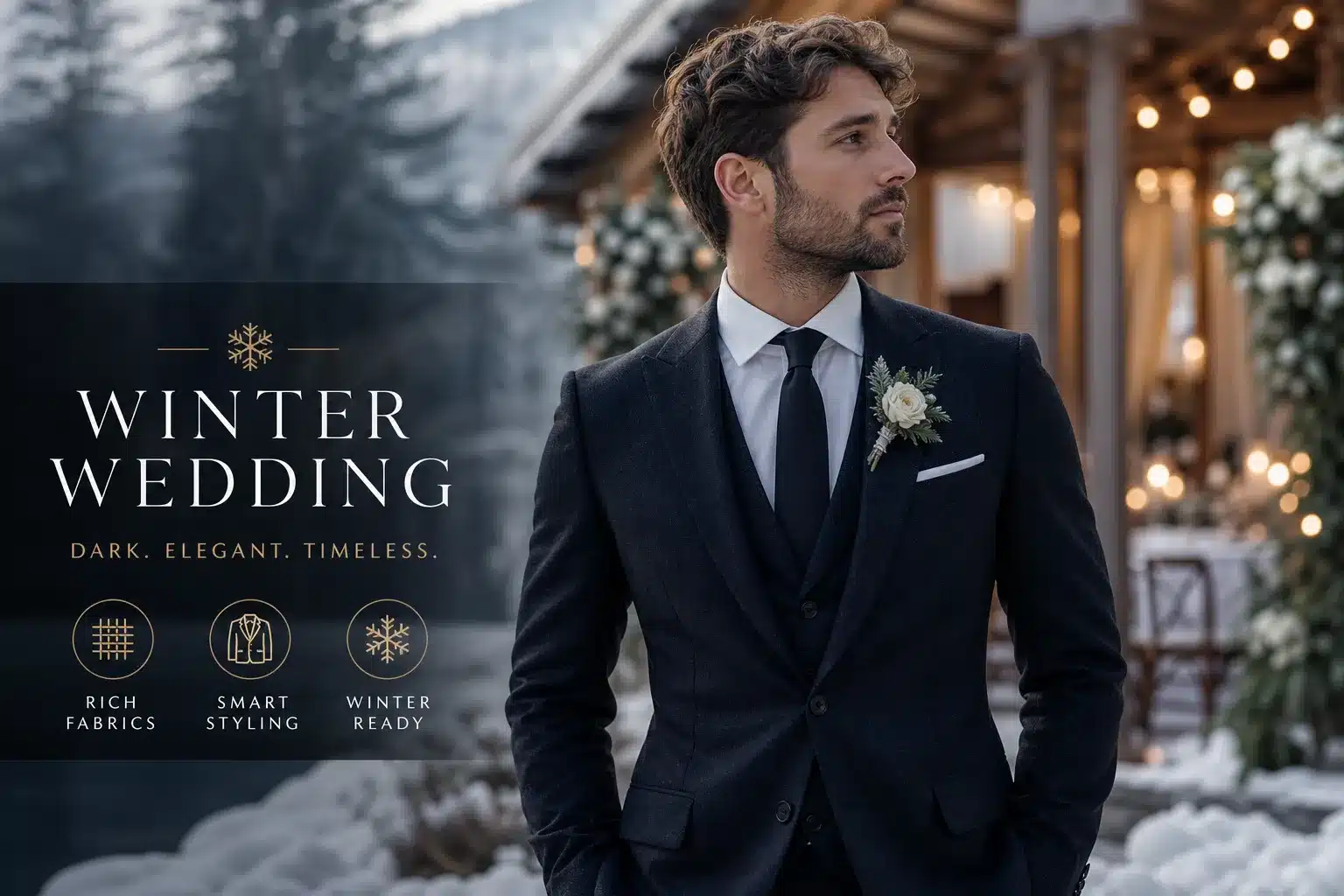

The fabric of a suit matters as much as the cut. You can have the sharpest shoulder line and the most precise lapel, but if the cloth doesn’t perform on your body, in your climate, and for your occasion, the suit will let you down. Scottish wool remains the benchmark for resilience and character in suiting, yet choosing between it, fine Italian worsted, summer linen, and Highland tweed isn’t a matter of personal preference alone. It’s a question of understanding how each fabric behaves, where it excels, and where it falls short.
At Gabucci Menswear Bath, we’ve been having this conversation with men for nearly 35 years. From our Milsom Street store in Bath, we advise on cloth selection across a bespoke range that spans the lightest summer linen through to full-weight Highland tweed. By the end of this article, you’ll know which fabric earns its place in your wardrobe and why.
Wool grown and spun in Scotland carries a natural crimp that gives suiting fabric genuine elasticity and recovery. Press it, sit in it, wear it through a long day, and it springs back to shape in a way that linen or fine worsted simply cannot match. It also handles moisture without losing its structure, a significant advantage in the British climate, where a suit needs to perform through unpredictable weather rather than only on dry afternoons.
The fibre diameter of Scottish breeds such as Shetland typically sits between 23 and 25 microns, positioning it in the fine-to-medium range. That translates to suiting cloth with real substance, typically 280, 350 gsm, which is noticeably heavier than Italian worsted. That additional weight is precisely what gives authentic Scottish wool cloth its characteristic resilience and structure.
Wool from Scottish flocks has a slightly more textured hand than its Italian counterpart. It isn’t coarse, but the surface carries a visible, matte depth that gives a suit genuine character. This texture results partly from how woollen yarn is spun: carded rather than combed, which creates a loftier, more irregular fibre that reads differently in light and movement compared to the smooth uniformity of a fine worsted cloth.
A well-made suit in authentic Scottish wool cloth doesn’t simply survive a single season. It develops with wear, holds its silhouette year after year, and carries a provenance that resonates with men who value authenticity in their wardrobe. Since September 2023, the Scottish Wool certification scheme, launched in Selkirk, has allowed consumers to identify products containing 100% wool sourced from Scottish farms, with every fleece hand-graded and traceable back to its origin. Look for that logo on the product label, and contact the certifying body directly if you wish to verify a specific product.
Italian worsted cloth is a fundamentally different fabric. Spun at lower micron counts, typically between 15 and 19 microns from fine Merino fibre, it is lighter, smoother, and falls with a fluid drape that reads as formally elegant. Italian mills such as Loro Piana and Vitale Barberis Canonico produce cloth that runs from around 210 to 280 gsm, sitting noticeably lighter on the body than Scottish suiting wool. In good light, it carries a subtle sheen. Against movement, it flows rather than holds.
The difference shows clearly when you compare the two side by side. Scottish wool suiting has depth and a matte, confident presence, while Italian worsted has a quiet luminosity and surface uniformity that lends itself to sharper, cleaner tailoring. Neither is objectively superior, each solves a different problem.
Italian worsted performs brilliantly for warmer months, indoor formal events, business travel, and occasions where polish and lightness are the priorities. If you’re wearing a suit to a summer wedding in a city venue, spending long hours under conference room lighting, or travelling between climates where a suit needs to look fresh out of a bag, fine worsted is the logical choice.
Scottish wool suiting holds its own wherever warmth, character, and resilience matter more than featherlight refinement. That’s a wide brief. For most men wearing a suit through the British year, cloth with that kind of performance range is a more practical long-term investment than the lightest possible worsted.
Linen is a plant fibre, not an animal one, and it behaves accordingly. It breathes exceptionally well, with an open weave structure that draws heat away from the body and wicks moisture quickly. For an outdoor summer wedding in direct sunshine, nothing keeps you cooler in the short term. It also carries a relaxed, slightly textured appearance that reads as effortlessly appropriate for warm-weather occasions.
The trade-off is worth understanding before you commit. Linen can crease within the first hour of wear in practice, and it lacks the recovery of Scottish wool entirely. It won’t hold a sharp silhouette across a full day. If photographs matter, and they typically do at a wedding, a pure linen suit will look progressively more relaxed as the hours pass.
Linen is a fair-weather fabric in the most literal sense. An outdoor summer wedding in July might justify it, but a linen suit on a cool or overcast British afternoon loses its appeal quickly. The breathability that makes it wonderful in sunshine becomes irrelevant, and you’re left with a creased suit that offers little warmth.
Linen-wool blends offer a useful middle ground. Adding 20 to 40 per cent wool introduces natural crimp and memory, helping the fabric resist deep creasing while retaining much of linen’s breathability. For most British summer occasions, a linen-wool blend is the more practical choice than a pure linen suit. Think of pure linen as a fabric that rewards the right occasion rather than a year-round wardrobe staple.
Tweed is woven, not worsted, and that distinction matters more than it might first appear. It is a thicker, rougher-textured fabric with a characteristic flecked or herringbone pattern, traditionally associated with the Scottish Borders and the Outer Hebrides. Harris Tweed, the most strictly certified of all Scottish textiles, protected by its own Act of Parliament, can reach 470 to 500 gsm: a weight that gives the cloth unmistakable presence and genuine warmth.
Compared to Scottish wool suiting cloth, tweed shares the heritage and fibre origin but is a fundamentally different fabric with a different purpose. Suiting cloth is woven tightly for drape and structure; tweed has an open, spongy weave designed for insulation and surface texture rather than formal silhouette. Both are Scottish in origin, but they are not interchangeable.
Tweed earns its place at country weddings, shooting weekends, rural events, and autumn or winter occasions where texture and warmth are virtues rather than liabilities. It reads as relaxed confidence rather than formal polish, and in the right setting it is one of the most characterful cloths a man can wear. A tweed jacket at a country estate wedding in October is a considered, confident choice.
Where tweed crosses the line is in urban formal settings, black-tie events, or any warm-season occasion where the weight becomes uncomfortable within the first hour. It isn’t a city suit fabric, and wearing it as one creates an awkward mismatch between cloth and context. Knowing where tweed belongs is part of wearing it well.
The key variables are straightforward: time of year, venue, formality of the event, and the role you’re playing on the day. A summer outdoor wedding calls for a linen suit or a lightweight wool blend, where breathability and relaxed elegance are appropriate, though bear in mind that genuinely lightweight Scottish wool suiting typically sits no lower than 280 gsm, so an Italian worsted or linen-wool blend is often the better summer choice. An autumn country wedding invites tweed, where texture and weight feel entirely at home. A formal city ceremony rewards Italian worsted or a fine Scottish wool suit, where polish and a clean silhouette are the priority.
If you’re the groom, the fabric choice carries additional weight. You’ll wear this suit through a ceremony and often several hours of reception, with photographs throughout. The cloth needs to perform across all of it. Fathers of the wedding party face a similar brief: they need to look considered and coordinated with the wider party without overdressing or underdressing the occasion.
Beyond weddings, the same framework applies. Italian worsted suits meetings, presentations, and business travel where lightness and polish are the expectation. Scottish wool suiting earns its keep in a suit you’ll wear season after season, through autumn, winter, and the cooler months of spring. Tweed suits smart-casual occasions where personality and texture matter more than formality. A linen or linen-wool blend is the right call for summer events where outdoor comfort takes precedence over precision.
Understanding fabric makes every purchasing decision sharper. When you know what a cloth is designed to do, you stop buying suits that look right in the shop and fail you everywhere else.
For many men, fabric is the last thing they consider when commissioning or buying a suit. It should be one of the first. The weight, weave, and fibre of a cloth determine how a suit performs across every occasion you wear it. A suit in the wrong cloth for your lifestyle is a suit that rarely gets worn, regardless of how well it’s made.
Choosing without understanding these properties is how men end up with expensive suits that disappoint them. The investment in a quality suit only pays off when the cloth is right for the life you actually lead. The consultation process exists precisely to close that gap.
This is precisely the conversation that happens at Gabucci Menswear Bath. Over three and a half decades of advising men on cloth selection, across a bespoke range that spans lightweight linen through to Scottish wool suiting and Highland tweed, means that fabric choice is part of the consultation from the start. It’s not an afterthought decided on the day of fitting. It’s the foundation that everything else is built on.
The in-house tailoring service and the consultative, no-pressure approach at the Milsom Street boutique in Bath means there’s genuine time to understand what you need the suit to do. Whether you’re dressing for a wedding, building a professional wardrobe, or investing in a suit that will serve you well across the British year, the right fabric conversation makes all the difference. Book a fitting appointment or browse the range, and start with the cloth.
These four cloths serve different men in different seasons. Scottish wool brings resilience and character, performing well across most of the British year. Italian worsted offers refinement and elegance, at its best in warmer months and formal settings. Linen earns its place at summer occasions that reward lightness over structure. Tweed belongs in country settings and cool-season dressing, where texture and warmth are the point.
None of these fabrics is universally superior. The right choice depends on your occasion, your climate, and how you want the suit to work for you over time. A man who understands his fabrics wears his suits with more conviction, because he chose them with real knowledge rather than guesswork.
Authentic Scottish wool, traceable to its source and woven into cloth with genuine heritage, rewards that understanding particularly well. It performs honestly, wears with growing character, and rewards the man who chose it knowingly. Choose Scottish wool for the right reasons and it will serve you for years.